LIFE AS MYTH

JOURNAL
JOURNAL 2026

The Jewel Box
JOURNAL 2025
The Atlas
JOURNAL 2024
JOURNAL 2023
Sabbatical
JOURNAL 2022
Moonbear museum
JOURNAL 2021
A peach of great price
JOURNAL 2020
Once upon a time
JOURNAL 2019
The golden thread
JOURNAL 2018
Mary & Co.
JOURNAL 2017
JOURNAL 2016
JOURNAL 2015
JOURNAL 2014
JOURNAL 2013
JOURNAL 2012
JOURNAL 2011
JOURNAL 2010
JOURNAL 2009
JOURNAL 2008
JOURNAL 2007
JOURNAL 2006
LIFEWORKS
ATLAS

COMING IN 2026
THE JEWEL BOX
"We must not see any person as an abstraction. Instead, we must see in every person a universe with its own secrets, with its own treasures, with its own sources of anguish, and with some measure of triumph" Eli Wiesel, writer, Holocaust survivor, Nobel Peace Prize 1986
Purkinje neuron from the human cerebellum. Santiago Ramón y Caja. 1901. Cajal Institute (CSIC), Madrid.
JOURNAL 2025
THE ATLAS
And don’t think the garden loses its ecstasy in winter. It’s quiet, but the roots are down there riotous.
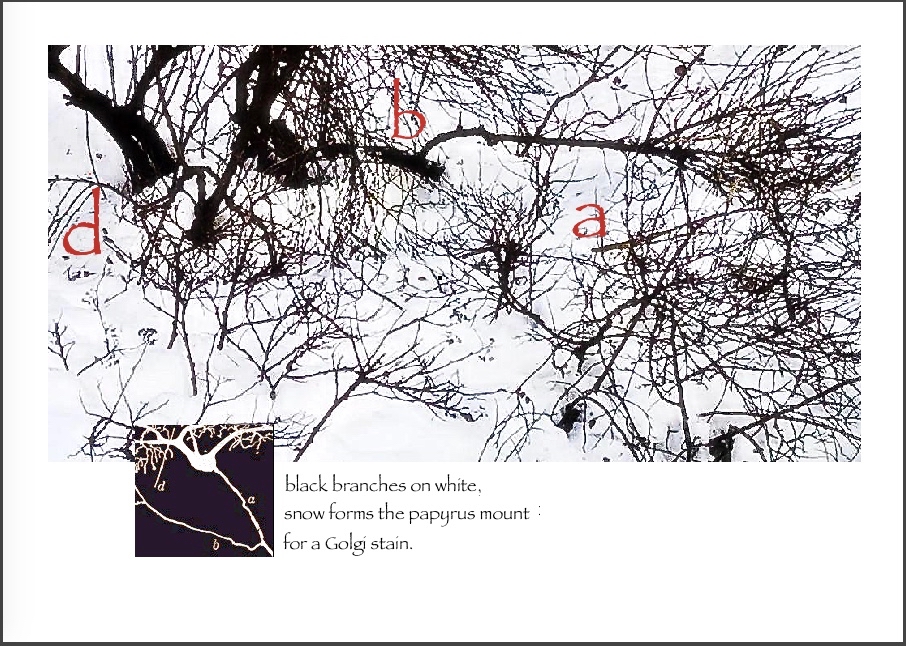
RumiIt began during a winter walk on New York's Upper West Side. It had snowed heavily that week and I stopped to take a picture of barren branches on an embankment. A few days later, I decided to manipulate the photo with different filters before posting it on social media. By increasing the contrast and exposure, the architecture of the branches sharpened. Like the brush strokes in Japanese ink wash art.
Weeks later I read about a touring exhibition of Santiago Ramon y Cajal's drawings. Looking at his work I recalled the branching lines in my winter photograph. Both had patterns found in Nature, his in a world too small for the human eye to see, mine in a world that is around us all the time. And I returned to the photo with inspiration for a piece of artwork.
Cajal's drawings are a remarkable example of the seminal, creative, re-orienting significance of pictures in science. It is so easy to overlook the importance of visualization to thought and discovery.
Alva Noë, The Art Of The Brain, On Exhibit, Cosmos & Culture: Commentary On Science And Society, NPR (January 17, 2017)Cajal created a vast body of work showcasing the human neuron. To do that he studied brain tissue stained with a new technique developed by Camillo Golgi. The collaboration between the two men resulted in a shared Nobel Prize for Physiology and Medicine (1906). What makes Cajal's work truly exceptional is not his graceful drawings of brain cells. It's more than that. His art displays an understanding of how those cells actually work. In other words, when Cajal was drawing he discovered a truth beyond the stained tissues in front of him, beyond what his eyes alone revealed.
And that is the takeaway for me -- how Cajal's work places the neuron in the context of something larger. In his extraordinary drawings, there are no unrelated individual cells but rather the mystery of an entire neural network, whose roots and arms are universal, repeatedly appearing throughout the created world, even in a tangle of winter branches erupting from a bank of snow.
(adapted from a daily journal June 2018 - 2019)
Golgi haiku, Usher. 2018.
When da Vinci is a woman, i (2020).
The life of cells triptych, ii. Usher, 2022. Intima: A Journal of Narrative Medicine [Columbia University], Fall 2022.
Purkinje neuron from the human cerebellum. Santiago Ramón y Caja. 1901. Cajal Institute (CSIC), Madrid.
WHAT CAME AFTER. . . field researchers can focus on observing key events or incidents. Fieldworkers may at first have to rely on their own experience and intuition to select noteworthy incidents out of the flow of ongoing activity.
Writing Ethonographic Field Notes, Emerson et al.Prior to New York and a writing life, I relocated to New York City to attend graduate school at New York University in clinical counseling. It was my time at NYU and most particularly an independent study in the final year that proved to be a watershed for my life. The independent study focused on the connections between gender bias, narrative and the emergence of the Self. That study reshaped my identity as a woman and as an artist. It also produced a self-narrative paradigm. I named my work the Scheherazade Projectl, after the famous Arabian storyteller of the same name, who told stories to save not only her own life but the lives of other women.
In 2006 I graduated from NYU and around that time I launched this web site, then called The Scheherazade Project. The goal was to have a place that I could have a voice, explore the narrative work I began at NYU and, quite simply, begin my writing life. Over that first year, I wrote about the three prongs of the project's narrative philosophy: mythology of self, mythology of other and mythology of planet. The focus was on feminine values, community and harmony, as opposed to masculine values, individuation and conquest.
I was slow in finding my way and there were frequent rewrites, editing, misdirection. The web site has been rechristened and reimagined several times. But, looking back now, I realize that is part of the process of discovering and claiming your own voice. It is also part of the process of discovering and naming your own life.
(L) A view from a bench in Brooklyn while drinking coffee and eating a pumpernickel bagel. Usher, 2015.
He needs a cigarette. He pats his shirt pocket looking for his pack and, only then, he remembers why he is here in a Brooklyn coffee shop. He glances back up; he sees her for the first time (he had almost missed her altogether); it is possible that he falls in love with her right now. Usher, Autumn 2016.
Wilton diptych (detail). Artist unknown. 1395. The National Gallery, London.
AUTUMN 2025
SQUARE WORD CALLIGRAPHY
The rebuilding of the cathedral after the fire coincided with my own life rebuilding. It was very powerful to walk in that sacred space as it slowly came back to life, coinciding with the birth of what my own life as a counselor and writer might be.
Picture Eight: Both ox and self transcended. Ten Oxherding Pictures. Attributed to Shubun (n.d.) Japan, Muromachi period.
National Gallery of Art, Washington DC. Usher. 2016.
The cathedral renovation ended with a rededication ceremony in November 2008, coinciding again with my own life as I began work as a counselor in a small outpatient mental health clinic.
The cathedral’s greatness lies in its commitment to the belief that faith expressed through engagement with the world is the only way faith is truly expressed.
The Very Reverend Dr. James A. Kowalski, dean, November 2008 rededication ceremonyThere is another way I connected to this space. After the cathedral recovered they sponsored an installation of the work of Xu Bing, a Chinese artist. His visionary sculpture is Phoenix, the mythological Chinese creature that transcends death. According to the artist, these two phoenix represent the struggle toward new values and insights about how to live in the modern world. The sculpture is made of found materials from a migrant workers camp in Beijing.
Phoenix is best understood within the theme of metamorphosis, which preoccupied Xu after moving to New York in 1990. In 1997, he invented a new writing system by fusing elements of the English and Chinese languages. Although his words look like Chinese characters, they are comprised of English letters. His audience was invited to learn this “unified” language in an environment resembling a traditional calligraphy classroom, complete with manuals, writing tools and desks. The whole project was entitled New English Square Word Calligraphy.
"Wood, Light and Steel from Ash: Xu Bing’s Phoenixes", Aileen June Wang, artcritical: an online magazine of art and ideas (June 30, 2014).I returned to this exhibition many times just before I moved back to Georgia that same spring. Here the life of the cathedral and mine intersect another time. Bookends, of sorts, for the cathedral and for my own life.
(adapted from a daily journal June 2018 - 2019)
Phoenix, Xu Bing. Installation at The Cathedral of St. John the Divine, New York, NY. Usher. 2014.
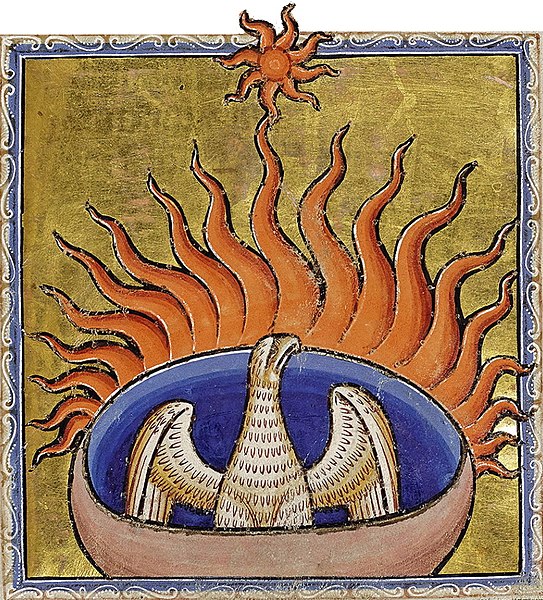
Phoenix. The Aberdeen Bestiary. 13th Century. Aberdeen University Library. Aberdeen, Scotland.
MODERN DEVELOPMENTS IN MARIOLOGY The book of hoursis a Christian devotional of writings, psalms and prayers, popular in the Middle Ages and intended for the laity. The books were usually in Latin though vernacular forms were not uncommon. The practice of reciting the hours was meant to provide the individual with a more immediate relationship with God and the Virgin Mary. The standard components included a calendar of church feasts, the Hours of the Virgin, the Hours of the Cross, the Hours of the Holy Spirit, the Office for the Dead, and the Suffrages.
The little office of the blessed Virgin Mary was and is a weekly devotional cycle consisting of psalms, hymns and sacred readings. It began in the eighth century as a monastic spiritual practice. By the tenth century it was in widespread use as a standard text in the book of hours. By the fourteenth century it was obligatory practice for all clergy.
This ritual remained common practice until mid-twentieth century when Pope Paul VI recommended that practitioners use the Divine Office in lieu of The little office of the blessed Virgin Mary. This decision by the Pope was consistent with other changes in the church calendar during the Second Vatican Council. Seen in the overall context of Pope Paul's many teachings on Mariology, the shift away from the Little office of the blessed Virgin Mary was an attempt to consolidate ritual practice rather than devalue the integral status of Mary within the Roman Catholic Church.
After the conclusion of the Second Vatican Council, the Little Office endured in print and practice as an alternative to The Divine Hours. This option accommodated those who simply preferred the Little Office over the Hours and also those who choose to center their daily spiritual practice around the Virgin Mary.
Marian devotion also found expression outside the liturgical hours. During the twentieth century, for the first time, the Roman Catholic Church recognized two Marian years. The first was in 1954 and celebrated the 100th anniversary of the of the proclamation of the dogma of the immaculate conception.
In 1987 Pope John Paul proclaimed the second Marian year, with the express purpose of embracing spiritual practices which the Second Vatican Council had found "primitive". The Pope had a particular affinity for the Virgin, invoking her intercession in prayer and making journeys to Marian sites. With the institution of the second Marian year, the Pope encouraged a return to the "warmth and simplicity" in spiritual practice lost after the Second Vatican Council. He placed an emphasis on liturgical tradition and celebration through the restoration of public processions along with pilgrimages to sacred sites dedicated to Mary.
The Virgin Mary remains an enduring part of spiritual practice in the twenty first century. Her shrine at Lourdes draws 5,000,000 pilgrims yearly. Each December millions more journey to the Basilica at Tepeyac Mexico for the feast day of Our Lady of Guadalupe. Mary is also the patron saint of numerous countries, serving as both intercessor and protectoress of her devotees.
The little office
of the blessed Virgin MaryMatins
AnnunciationLauds
VisitationPrime
NativityTerce
Annunciation to the shepherdsSext
Adoration of the MagiNone
Presentation in the templeVespers
Flight into EgyptCompline
Coronation of Mary
SUMMER 2025
A STORY TOLD IN THREES
3.12.22
NEW YORK, NEW YORK
Lewis Hine, an American photographer, studied sociology at the University of Chicago, New York University and Columbia University. This extensive education along with his personal experience of labor exploitation influenced Hine to use photography as a tool for social change. His photography of child workers was instrumental in the eventual enactment of child labor laws.
#lewishine #childlabor #spinner #vintagephotography #factoryworker
URSA MAJORThe Moonbear Museum © is a multi-media narrative project that is "a story told in threes". A curated collection of film, photography, artwork and creative writing form a larger whole, a story that blurs traditional rules of language and communication.
The Ursus thibetanus, also known as the Tibetan moon bear, is a species native to the Himalayas. They are omnivorous, nocturnal, small in stature and adapted to life in the trees. The International Union for Conservation of Nature has classified the bear as vulnerable due to habitat loss and the value of their body parts for traditional medicines.
During the mid-twentieth century the American military used live Himalayan and American black bears to test pilot ejection capsules on supersonic bombers. Their experiments included ejection at up to 45,000 feet.
Animal injuries were usually not serious but military protocol included the euthanizing of all bears afterward in order to perform autopsies.
Moon Bear polyptych, detail, 2020.
SPRING 2025
TEACHERS AND LEARNERS
Injustice anywhere is a threat to justice everywhere. We are caught in an inescapable network of mutuality, tied to a single garment of destiny. Whatever affects one directly, affects all indirectly.
Dr. Martin Luther King [1929-68], clergyman and civil rights activistIn July 1961, Adolph Eichmann was on trial for Nazi war crimes. During the same time period, Stanley Milgram, a psychologist at Yale University, was conducting an experiment in social psychology which attempted to address the questions about human nature that the atrocities of the Nazi regime posed. His experiment measured the willingness of participants to inflict pain on another human being in order to obey an authority figure.
The experiment worked in the following way. When volunteers arrived at the test center, the testing officials alternately assigned the volunteers the roles of "Teacher" or "Learner." The Learner sat strapped in a chair in one room while the Teacher sat with the testing official in another. The Teacher tested the Learner on correct responses to word pairs. For each incorrect answer, the Teacher administered an electrical shock to the Learner. Each time an incorrect answer was given the shock intensity increased an additional 15 volts, up to a maximum of 450 volts. Throughout the experiment, the volunteer Teacher was unaware that the Learner was, in fact, an actor or student participant who was never actually harmed.
. . . Stark authority was pitted against the subjects' [participants'] strongest moral imperatives against hurting others, and, with the subjects' [participants'] ears ringing with the screams of the victims, authority won more often than not. (Stanley Milgram, 1974)
Variations on the test yielded different results. For example, Milgram found that Teachers were more willing to administer the shocks, if the Learner was in another room and the source of authority (test supervisor) was close at hand. If Learners sat in the same room as the Teachers, however, Teachers became noncompliant and refused to continue the experiment.
What is cruelty? Simply put, cruelty is to act without regard to the pain caused to another, to even take pleasure in the pain caused. Is humanity distinguished from the rest of creation by its capacity for cruelty? Or are we actually no different from the natural source from which we spring? To observe Nature is to experience a cosmic opera of both beauty and brutality. In Pilgrim at Tinker Creek, Annie Dillard observes the inherent savagery in the cycle of life and then writes: Cruelty is a mystery, and the waste of pain. In other words, suffering and brutality are part of the natural order. Cruelty, however, is unique to Humankind.
A recent report [Los Angeles Times] by Melissa Healy examines new research from Poland and finds little change in human behavior since the Milgram experiment fifty years ago: individuals are still likely to inflict pain on others in deference to authority.
"Would you deliver an electric shock at someone's orders? A new take on the Milgram experiment shows the answer is likely still yes", March 15, 2017, Los Angeles Times.Do we all have the potential for cruelty? The Milgram experiment seems to say yes. It also seems to reveal certain circumstances that make cruelty more or less likely. Distance from the victims is one factor and release from personal responsibility (obedience to authority) is another. With proximity to human suffering, and by assuming individual responsibility for how our actions contribute to that suffering, we will lessen the likelihood of cruelty and the wasted pain it creates.
Panocticon, Usher. 2015. Assigned to the Riddlespeak series.
Three things cannot be long hidden: the sun; the moon; and the truth.
Buddha (paraphrased)Three things cannot be long hidden: the sun, the moon and the truth.
Buddha
ART & ARTIFACTS
Other neuroimaging studies Van der Kolk has collaborated on since also showed that the executive functions of the brain become impaired when traumatized people try to access their trauma. “The imprint of trauma doesn’t “sit” in the verbal, understanding, part of the brain, but in much deeper regions-amygdala, hippocampus, hypothalamus, brain stem-which are only marginally affected by thinking and cognition. These studies showed that people process their trauma from the bottom up-body to mind-not top down.”
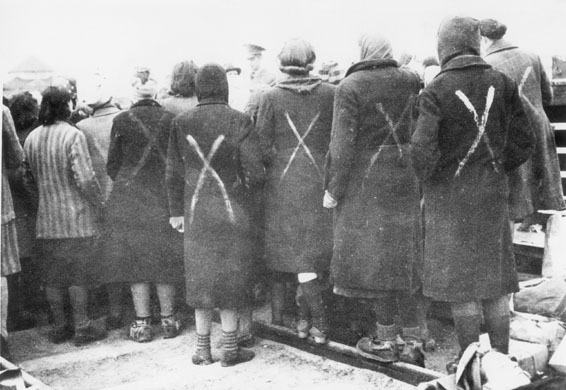
"The Limits of Talk: Bessel van der Kolk wants to transform the treatment of trauma", Mary Sykes Wylie, Psychotherapy Networker, January/February 2004This image (circa 1945) documents women prisoners at Ravensbrück, a World War II concentration camp north of Berlin. During the war over 130,000 women were held at the camp. The largest ethnic group was Polish. Prisoners were subjected to forced labor and nonconsensual medical testing. Conditions in the camp, acceptable at the commencement of the camp's operation, deteriorated and by the end of the war there were only 15,000 survivors. Prison personnel, recognizing the end of the war and liberation, forced most of the prison population into a death march, hoping to kill witnesses who could testify to the camp's activites.
There are reports of resistance which included secret educational programs led by experienced prisoner-teachers and the creation of personal artifacts like jewelry, small dolls and books. There is a major collection of surviving works on exhibition at Lund University Library, Sweden ("Voices from Ravensbrück").
Women at the concentration camp at Ravensbrück, marked with Xs, preparing for transport.
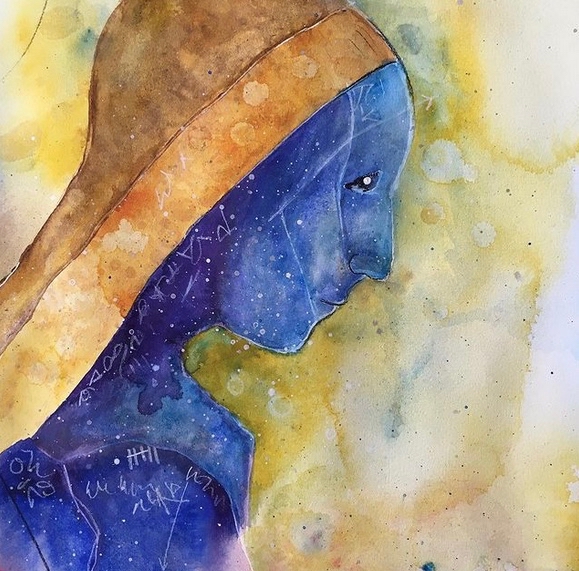
Self portrait of the artist, watercolor series. Usher. 2011.
Panocticon, Usher. 2015. Assigned to the Riddlespeak series.
WINTER 2025
MOONBEAR MUSEUM
My very first memories are of my childhood home, Lamara Apartments, a duplex community in Savannah, Georgia. It is January, just after my sister was born. I am sitting on the concrete stoop and the green space just outside our duplex sparkles with snow. Just past my feet there is a tiny snowman that my mother made; its eyes are two small pieces of red cinnamon candy and they are slowly staining the snow a deep rose red. My mother leans out the back door and checks on me and then returns inside. A new sister and a miraculous Savannah snow, my toes and fingers aching with cold, a small snowman with stained cinnamon eyes. The first memories of home.
Flash forward many decades to another place, another time and another snow.
In the winter of 2014, I was living in the upper most reaches of Manhattan and it was to be my last New York winter. It snowed heavily, stirring that old childlike thrill as it thudded against coat, caught on eyelashes and hair, crunched beneath boots.
My big dog Sophie and I took long walks in the nearby nature preserve. Sometimes I let her off leash and she barreled forward, her nose buried in the powdery white, occasionally turning her head over her shoulder to feast on feathery flakes caught in her fur.
But, for all the snowy magic, something was missing -- a sense of roots, of safety and belonging maybe, a sense of home. This was not home as I knew it -- the one from my coastal Savannah childhood, all marsh mud and chiggery Spanish moss and salt sea air. Not like the one from my midland Georgia adulthood either, with a crookedy cottage on a crookedy creek, sandy flood plain alive with chipmunks and slippery black snakes, and a Great Blue Heron walking the creeks shoals on stilted legs looking for fish. Somewhere "home" waited for me and in the spring of 2014 I decided to leave New York and return to Georgia, the last place I remembered that felt like "home".
The return to Georgia has gone in very unexpected directions. It feels less like taking up where I left off and more like starting all over again. And if I thought moving back would mean fewer problems and cares. Well, wonder of wonders, the problems I had to manage in New York have followed me down the eastern seaboard and set up residence here as well.
Hmmm. Is it possible for any of us to find our way home again? The answer is no and yes. On the one hand, no, we can't return to the worlds of our childhood or our young adulthood or whatever familiar and comfortable "home" where we once resided. On the other hand, yes, we can. Or, to put it another way, -- yes, we can return home.
Home is knowing. Knowing your heart, knowing your mind, knowing your courage. If we know ourselves, we're always home, anywhere.
This homey quote is probably familiar to you if you have ever witnessed the exchange between Glinda the Good Witch and Dorothy at the conclusion of The Wizard of Oz.
Here's my own personal returning-to-Kansas-discovery. Somewhere in me still lives the child from the Savannah beaches and marsh, the mother and wife and artist of the North Georgia creeks and flood plains. I treasure those times but I remember them (I hope) with as little nostalgia as possible. The key has been to truthfully hold the reality of home, allowing for both its perfections and its flaws. Somewhere in that idea, there is a truth that is larger than "home". Somewhere in that idea of home, there is a key to how we hold our relationships, our work, our lives, about how we hold our very world in our hands.
You always had the power, my dear. You just had to learn it for yourself.
Glinda again to Dorothy.
I return again to home, my new-old home, and the place I dreamed about during a snowy winter in New York. In my neighborhood there are eight free-range chickens five doors down. From time to time their eggs are for sale on Facebook. One homeowner recently hired a herd of goats to clear thickets out of an ovegrown greenspace. There is another neighbor who has built a small dog house in their side yard for the exclusive use of a territorial possum (who never plays dead). At Christmas the entire area is a crazy display of over the top lights and inflatable decorations.
My little house remains a stenciled-half-painted-patched-up-work-in-progress but welcomed the first official family celebration a few years back. And just before that first crowded celebration began, in a neighborhood park, on a small wooden bridge near a stand of dancing water grasses, my son gave his fiancé her ring. My hands are reverently holding it all, a home brimming over with chickens, goats, stenciled floors, crazy holiday lights, possum houses and love on a bridge over water grasses.
. . . My particular edition of Pilgrim’s Progress was an abbreviated one and featured whimsical stick figure illustrations. The sole feature that distinguished Pilgrim from the rest of the company was a simple egg-shaped loop on the back, representing a “great burden.”
I thought about Pilgrim’s Progress throughout the winter of 2014, along with the great burden on my back, a burden I could not or would not abandon. I also thought about Pilgrim’s final companion, Hopeful, who did nothing to lighten Pilgrim’s burden on the way to the Celestial City. Rather, Hopeful simply made it possible to complete the journey.
A winter walk in the Shorakapok Preserve in Inwood Hill Park, Manhattan. Maintained by the New York City Parks Department, the preserve holds some of the only natural forest and salt marsh in Manhattan. There are numerous hiking trails, featuring caves formed by natural rock overhangs and once used by Native Americans.
STORY TELLING SEASONSamhain approaches. It's an ancient holiday, officially beginning at sunset on October 31.* Lasting three days, Samhain marks the end of the harvest and the beginning of the "dark half" of the year. According to Celtic mythology, it is a time of enchantment, a time when both mortal and immortal can pass back and forth between this world and the Otherworld. Like many of the Celtic holidays, Samhain aligns exactly with a Christian observance -- All Hallows Eve, All Saints Day, and All Souls Day (October 31- November 2).
Samhain marks the time of year when the ancient Celts began their storytelling cycles, gathered as a community around the winter fires. This cycle continued throughout the "dark half" of the year, until Beltane, May 1, when the warm weather and agricultural duties required full attention.
Recognizing the approach of the storytelling season, I have put together a narrative cycle of my own. This fall I am revisiting the Ten Oxherding pictures. What I particularly like about this series is how the path to enlightenment concludes by returning us to the world and the human experience. The series reflects precepts of Zen meditation, a Japanese tradition of Buddhism (Mahayana) that emphasizes a combined spiritual practice of meditation and intuition. In other words, in order to truly understand these images, we must reflect and intuit their meaning.
The writing that accompanies these illustrations incorporates ideas from this web site. In that way, this particularly telling of the Ten Oxherding pictures explores the idea of a living myth. And if you take time to reflect and intuit, you might discover more than the writing itself.
*Samhain celebrations traditionally coincide with All Hallow's Eve (Halloween, October 31). However, Samhain is a cross-quarter day, meaning the actual date lies at the midpoint between the autumn equinox and the winter solstice. Varying from year to year, in 2013/2017/2022 the date is November 7.
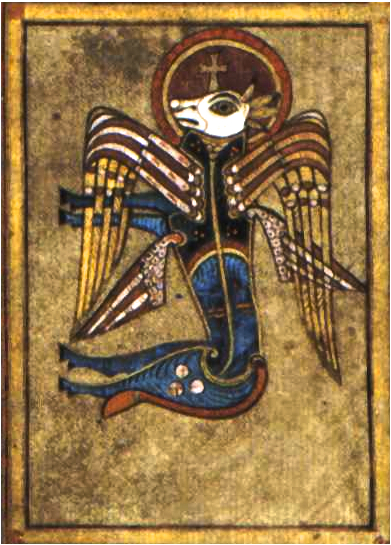
The four evangelists (detail, St. Luke as the ox). The Book of Kells. Trinity College, Dublin. ca. 800 AD.
This winged ox is the spiritual symbol of St. Luke. Luke was an apostle of Christ, a doctor and a writer (Gospel of Luke, Acts of the Apostles). Tradition also credits him with the creation of the first icon of Mary and Jesus. The Guild of Saint Luke, one of the earliest artists guilds, takes its name from this legend. Luke is the patron saint of artists and healers. His feast day is October 18.
Ox: ochse, German origin; also Dutch os, from the Sanskrit uksan, meaning bull; in Zen Buddhism, a symbol for enlightenment.
JOURNAL 2024
BRAVE NEW WORLD
MIRANDA [rising and coming forward]:
O wonder!
How many goodly creatures are there here!
How beauteous mankind is! O brave new world
That has such people in ’t!
The Tempest, (V.i) William Shakespeare. 1611.
It is difficult to describe what the sky and the water do here -- but it is like they are one seamless curtain of silk, a silk that is every shade of blue. Because the horizon is so open, you can see an unlimited expanse of that blue silk and it ripples and shifts every time the light breaks through the clouds to dance on some distant stretch of waters.
At the furthest most point, there is a beautiful beach with fine white sand. It sits in a deep basin with mountains rising up on either side and the water is a deep turquoise which turns powder blue further out. In the distance you see the backs of blue-violet mountains rising out of the ocean.
The Celts told of a place called Mag Mell. According to their myth, you only find it by accident -- usually when you are in a boat which is driven off course by a storm. What makes this Celtic paradise different from others in world mythology is that it is not an afterlife realm of shadows or eternal punishment. It is something altogether different. Mag Mell, meaning "the plain of joy," is a place of eternal youth and beauty, a place where sickness and death do not exist, a place where all those things which are beautiful in this Life finally come together.
Life as Myth, Collected writings, Usher. (2006 - ).
The time polyptych:Future continuous, panel 3, (2021- ). Watercolor, charcoal and ink on paper. 24 x 30 in / 61 x 79 cm.
(above, left) Self portrait at Keem Beach. Achill Island, Ireland. Usher. 2008.
AUTUMN 2024
FINDING JOY
Truth, Goodness, Beauty -- those celestial thrins,
Continually are born; e'en now the Universe,
With thousand throats, and eke with greener smiles,
Its joy confesses at their recent birth.
The journals of Henry David Thoreau [June 14, 1838]
Someone in the southeastern United States recently bought one of my paintings and yesterday I mailed it to him. In order to save shipping costs, I packed the box myself. The end result weighed just over seven pounds and measured an unwieldy 33" by 41" by 3". In other words, though light in weight, the box was still long enough and wide enough to be extremely difficult to carry. Unwieldy-ness notwithstanding, since the Fed Ex satellite store was only a few blocks away, I decided to carry it there myself.
While making my way up Broadway, the box slipped and shifted constantly. I tried several ways of carrying it but none worked for very long. Finally I had an inspiration and lifted the box up to my head and in that way I successfully made it to the Fed Ex store. What a comical sight I must have made, like some Dr. Seuss imagining -- a quite tall, so freckled, white lady with a box growing out of her head.
Which brings me to what happened yesterday on the way to the Fed ex store: I experienced the workings of my mythic eye. My lens on the world is my "mythic eye." That means I tend to use symbols and metaphors when interpreting the world around me. And yesterday my mythic eye contemplated the spectacle of walking down Broadway with a box growing out of my head and saw something larger.
It's kind of hard to explain but in that particular moment I felt connected to other women, possibly all other women, women and how they work through their day, whether raising children or governing countries or walking around with boxes on their head. And I saw my part in that bigger picture as both unique and yet also universal. For a few moments I experienced the beautiful groove of my life and how amazing that felt to be in it. And interestingly, I understood in that moment that joy is not only found at my easel -- but it is also found in the simplest experiences of everyday life.
Life as Myth, Collected writings, Usher. (2006 - ). Adapted from a 2006 essay.
EEG: a measure of Joy. Usher. 2013. Private collection.
Henry David Thoreau was an essayist and poet, influential to Mahatma Gandhi's thinking on passive resistance.
AUTUMN 2024
GLIMPSING BEAUTY
Beauty is truth, truth beauty,—that is all
Ye know on earth, and all ye need to know.
John Keats, English poet
Many years ago, my sons and I lived in a little cottage in the woods. One summer evening, around sunset, we were all on the front porch together. Our dog was lying at one end of the porch, panting heavily from the heat. The overhead porch fan, slightly off-balance in its cradle, clicked back and forth, blades whirring. The boys were blowing soap bubbles to pass the time, each competing with the other to create the largest one. The front porch filled with bubbles, floating, catching in the updraft of the fan, before bursting, pattering across porch planks.
Then my younger son blew a goliath of a bubble that began dancing toward me. That’s when it happened. It felt like Time slowed or maybe I simply paid very close attention but I saw such beauty. It wasn’t just the bubble cha-cha-ing toward me. It had to do with my children and how much we loved each other but it also had to do with the sunset, the clicking of the fan, the dog’s deep breaths. All of it was integral to what this was. That crazy bubble began trembling and shivering and the light from the sunset skated all over it. I knew it was going to explode and then it did and that was deeply beautiful too.
That was eternal beauty. Yes, the particular experience is over. Bubbles popped, children grew up, and the same sun has gone down and come back up many, many times. It doesn't matter. What remains is that glimpse of Beauty, absolute and whole, and that is all I can know on earth, and all I need to know.
Collected writings, Usher. (2002 - ).
The time polyptych: Past continuous, panel 1, (2021- ).Watercolor, charcoal and ink on paper. 24 x 30 in / 61 x 79 cm.
I appreciate the power of great writers to harness poetic metaphors to capture what is beyond words. These lines of verse from Keats' Ode to a Grecian Urn do just that. They describe the intimate relationship between beauty and truth. Beauty and truth, artists teach us, are the foundational underpinnings of creativity and art. According to Keats, truth and beauty are the foundation of life itself.
Life As Myth, collected writings: "Truth and Beauty", Usher (2007).
AUTUMN 2024
DISCOVERING TRUTH
You always had the power, my dear. You just had to learn it for yourself.
Glinda to Dorothy, The Wonderful Wizard of Oz, L. Frank Baum (1900)
My first memories are of my childhood home, Lamara Apartments, a duplex community in Savannah, Georgia. It is January, just after my sister was born. I am sitting on the concrete stoop and the green space just outside our duplex sparkles with snow. Just past my feet there is a tiny snowman that my mother made; its eyes are two small pieces of red cinnamon candy and they are slowly staining the snow a deep rose red. My mother leans out the back door and checks on me and then returns inside. A new sister and a miraculous Savannah snow, my toes and fingers aching with cold, a small snowman with stained cinnamon eyes. The first memories of home.
Flash forward many decades to another place, another time and another snow.
It's winter 2014. I am living in the upper most reaches of Manhattan. It will be my last New York winter. It is snowing heavily, stirring that old childlike thrill as it thuds against coat, catches on eyelashes and hair, crunches beneath boots. My big dog Sophie and I take long walks in the nearby nature preserve. Sometimes I let her off leash and she barrels forward, burying her nose in the powdery white, occasionally turning her head over her shoulder to feast on feathery flakes caught in her fur.But, for all the snowy magic, something is missing: a sense of roots, of safety and belonging maybe, a sense of home. This is not home as I knew it -- the one from my coastal Savannah childhood, all marsh mud and chiggery Spanish moss and salt sea air. Not like the one from my midland Georgia adulthood either, with a crookedy cottage on a crookedy creek, sandy flood plain alive with chipmunks and slippery black snakes, and a Great Blue Heron walking the creeks shoals on stilted legs looking for fish. Somewhere "home" waits for me and in the spring of 2014 I will decide to leave New York and return to Georgia, the last place I remember that felt like "home".
The return to Georgia has gone in unexpected directions. It feels less like taking up where I left off and more like starting all over again. And if I thought moving back would mean fewer problems and cares -- well, wonder of wonders, the problems I had to manage in New York have followed me down the eastern seaboard and set up residence here.
Hmmm. Is it possible for any of us to find our way home again?The answer is no and yes. On the one hand, no, we can't return to the worlds of our childhood or our young adulthood or whatever familiar and comfortable "home" where we once resided. On the other hand, yes, we can. Or, to put it another way, -- yes, we can return home because -- "Home is knowing. Knowing your heart, knowing your mind, knowing your courage. If we know ourselves, we're always home, anywhere." This homey quote is probably familiar to you if you have ever experienced the exchange between Glinda the Good Witch and Dorothy at the conclusion of The Wonderful Wizard of Oz.
Here's my own personal returning-to-Kansas-discovery. Somewhere in me still lives the child from the Savannah beaches and marsh, the mother and wife and artist of the North Georgia creeks and flood plains. I treasure those times but I remember them (I hope) with as little nostalgia as possible. The key has been to truthfully hold the reality of home, allowing for both its perfections and its flaws. Somewhere in that idea, there is a truth that is larger than "home". Somewhere in that idea of home, there is a key to how we hold our relationships, our work, our lives, about how we hold our very world in our hands.
I have returned home, my new-old home, and the place I dreamed about during a snowy winter in New York.In my neighborhood there are eight free-range chickens five doors down. From time to time the eggs are for sale on Facebook. One homeowner recently hired a herd of goats to clear out a side yard overtaken by thickets. There is another neighbor who has built a small dog house in their side yard for the exclusive use of a territorial possum (who never plays dead). At Christmas the entire area is a crazy display of over the top lights and inflatable decorations. During a downpour, my garage floods, the storm drain clogged with eroded landscape mulch. My little house is still a stenciled-half-painted-patched-up-work-in-progress but welcomed the first official family celebration earlier this year. And just before that celebration, in the neighborhood park, on a small wooden bridge near a stand of dancing water grasses, my son gave his fiancé her ring. My hands are reverently holding it all, a home brimming over with chickens, goats, stenciled floors, crazy holiday lights, possum houses and love on a bridge over water grasses.
Life As Myth, collected writings: "Tap Your Heels Three Times", Usher (2016).
The time polyptych: Present continuous, panel 2, (2021- ).Watercolor, charcoal and ink on paper. 24 x 30 in / 61 x 79 cm.
AUTUMN 2024
CREATING HARMONY
The horizon leans forward, offering you space to place new steps of change.
Maya Angelou, writer and civil rights activist
In 2003, I moved to New York City to attend graduate school in psychology at New York University. It was my time at NYU and most particularly an independent study in the final year that was a watershed for my life. The independent study focused on the connections between gender bias, narrative and the emergence of the Self. That study reshaped my identity as a woman and as an artist. It also inspired a self-narrative paradigm. I called my work the Scheherazade Project. Scheherazade is the famous Arabian storyteller who told stories to save not only her own life but the lives of other women. Her storytelling cycle prevented the death of countless women and, very importantly, it transformed the heart of a kingdom.
In 2006 I launched a web site, The Scheherazade Project (scheherazadeproject.com). The goal was to have a place where I could have a voice, explore the narrative work I began at NYU and, quite simply, begin my writing life. Over that first year, I wrote about the three prongs of self-narrative: mythology of self, mythology of other and mythology of planet.
This paradigm emphasizes feminine values. Feminine values, also known as intrinsic values, focus on the importance of community and harmony, as opposed to masculine values which center on the elevation of the individual and the mastery of the environment.
The way we tell our stories directly affects the way we live our lives. And our storytelling is largely based on the monomyth, also known as the hero's journey. The monomyth has several distinctive characteristics. It almost always centers around a male hero. It also values skills which enable this hero to master the environment and realize personal achievement (e.g., rewards, recognition). These values are commonly referred to as extrinsic or masculine. What can be lost when our stories are skewed to the masculine is a recognition of our essential interdependence with creation and each other.
The Scheherazade paradigm, on the other hand, emphasizes intrinsic or feminine values. Feminine values are grounded in harmony as opposed to conquest, in community as opposed to the individual, in relationship and inclusiveness as opposed to individual power and reward.
This shift toward the feminine that the Scheherazade Project incorporates is important both individually and globally. On an individual basis, feminine values are the ones that are more strongly correlated with a sense of well-being and satisfaction with life. This is true for both men and women as they age. On a global level, an embracing of feminine values is a necessary step toward lessening hostility and violence. By focusing on our interconnectedness, we can create a world in which there are fewer divisions between us, a world in which we share more equally in our natural resources and abundance, a world in which we exist in harmony with each other and with our environment.
This way of telling our stories is not meant to be a one-size-fits-all paradigm. Your personal myth or story will reflect the wisdom, values and experience which are unique to you and your life. But this paradigm shift can serve as a starting point for you, a springboard to new imaginings of your life and our world.
Life As Myth, collected writings: "The Scheherazade Project", Usher (2006).
The time polyptych: Future continuous, panel 3 (2021- ). Watercolor, charcoal and ink on paper. 24 x 30 in / 61 x 79 cm.
Harmony [noun]
an interweaving of different accounts into a single narrative
“Harmony.” Merriam-Webster.com Dictionary, Merriam-Webster, https://www. merriam-webster.com/dictionary/ harmony. Accessed 18 Aug. 2024.
SUMMER 2024
OF WONDER
THE STAR
Twinkle, twinkle, little star,
How I wonder what you are!
Up above the world so high,
Like a diamond in the sky.
When the blazing sun is gone,
When he nothing shines upon,
Then you show your little light,
Twinkle, twinkle, all the night.
Then the trav'ller in the dark,
Thanks you for your tiny spark,
He could not see which way to go,
If you did not twinkle so.
In the dark blue sky you keep,
And often thro' my curtains peep,
For you never shut your eye,
Till the sun is in the sky.
'Tis your bright and tiny spark,
Lights the trav'ller in the dark:
Tho' I know not what you are,
Twinkle, twinkle, little star."The Star", Jane Taylor. From Rhymes for the Nursery by sisters Jane and Ann Taylor (London 1806). Lyrics later adapted for a lullaby.
Star birth, (2019). Usher. Private collection.
There is stardust in your veins. We are literally, ultimately children of the stars.
Jocelyn Bell Burnell, astrophysicist
SUMMER 2024
OF CHILDHOOD
spring and memories
of a childhood then and now
banana shrub bloomsThe collected works of Moonbear Museum, Usher. (2022).
Irish ceramic vase. Rosemarie O’Toole and Seamus Laffan, 21st c.
Magnolia figo aka banana shrub aka contained smile flower (Chinese). Native to China and used as an evergreen hedge in Shanghai.
It really is the most poetic thing I know about physics: You are all stardust.
Lawrence Krauss, theoretical physicist#one #cryptograms #artifacts #naturephotography #markmaking #composition #shawdowandlight #handthrownpottery #haiku
SUMMER 2024
OF CHILDREN
A firefly display in the twilight tonight.
The park pathway where I walk
fills with bright yellow diamonds
on gray faerie wings,
Wild starry hordes in shadows,
brushing across my hands and my feet.
I recall another twilight and another place.
Fireflies dance over meadow grass
and my children,
so young fledglings,
darting through shadows,
with their cries and their light.
Life as Myth, Collected writings, "Fireflies", Usher. (2006 - ).
River walk with lamplight and stars. Usher (2012).
Life is a luminous halo, a semi-transparent envelope surrounding us from the beginning of consciousness to the end.
Virginia Woolf (1882-1941), British writer and essayist
SUMMER 2024
OF THEN AND NOW
Moon waxing fuller
Tidal swells in marsh grasses
Woman great with child
Collected unpublished works (2006 - ), "Moonrise" (2019), Usher.
The life of cells, panel ii. Usher (2022).
“Watercolors magnify a microscopic part of our bodies, allowing us to reflect on its wonders.” @intimajournal (Columbia University) Life of Cells: A Triptych Study, ii.
Neil DeGrasse, astrophysicist and writer
SPRING 2024
I AND YOU
Had I the heavens' embroidered cloths,
Enwrought with golden and silver light,
The blue and the dim and the dark cloths
Of night and light and the half light,
I would spread the cloths under your feet:
But I, being poor, have only my dreams;
I have spread my dreams under your feet;
Tread softly because you tread on my dreams."Aedh Wishes for the Cloths of Heaven"
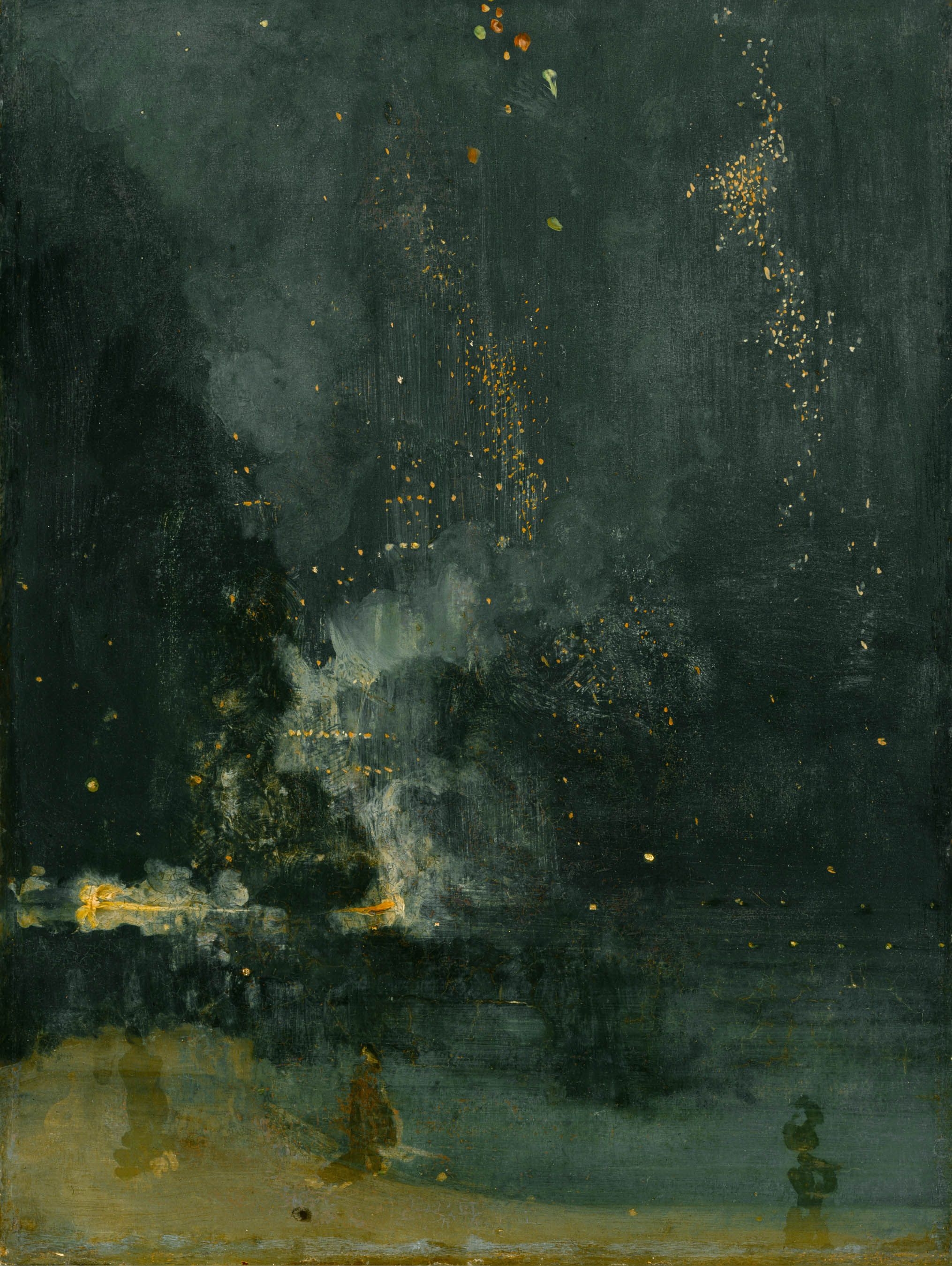
W. B. Yeats (1865 – 1939), Irish poet and playwrightNocturne in black and gold, (1874). Whistler. Detroit Institute of the Arts. The painting is based on the well known fireworks displays at Crenmore Gardens
SPRING 2024
YOU AND I
Had you the heavens' embroidered cloths,
Enwrought with golden and silver light,
The blue and the dim and the dark cloths
Of night and light and the half light,
You would spread the cloths under your feet:
But you, being poor, have only my dreams;
You have spread my dreams under your feet;
Tread softly because you tread on my dreams."You and I" (Usher), a meditation on "Aedh Wishes for the Cloths of Heaven" W. B. Yeats (1865 – 1939), Irish poet and playwright
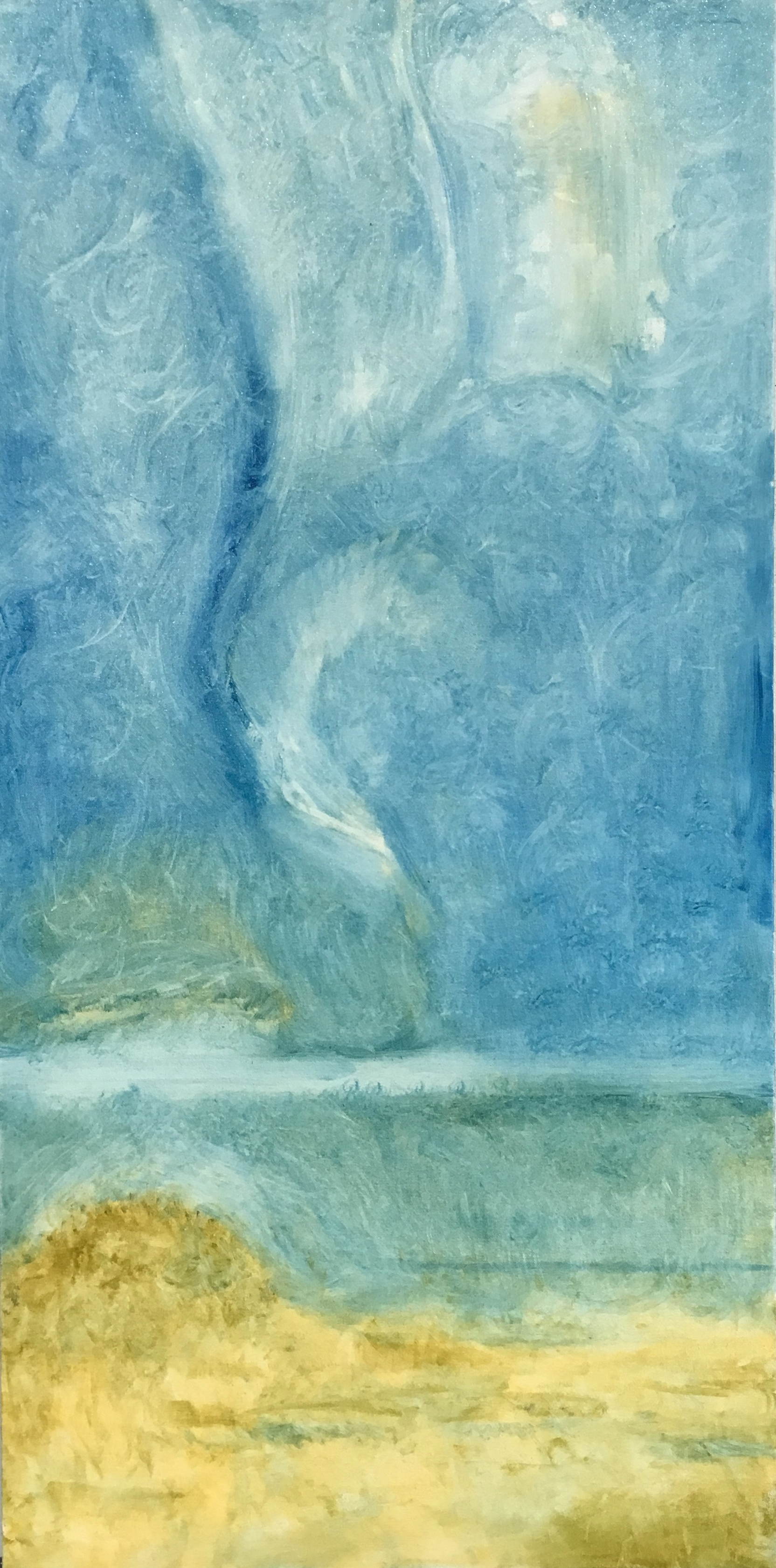
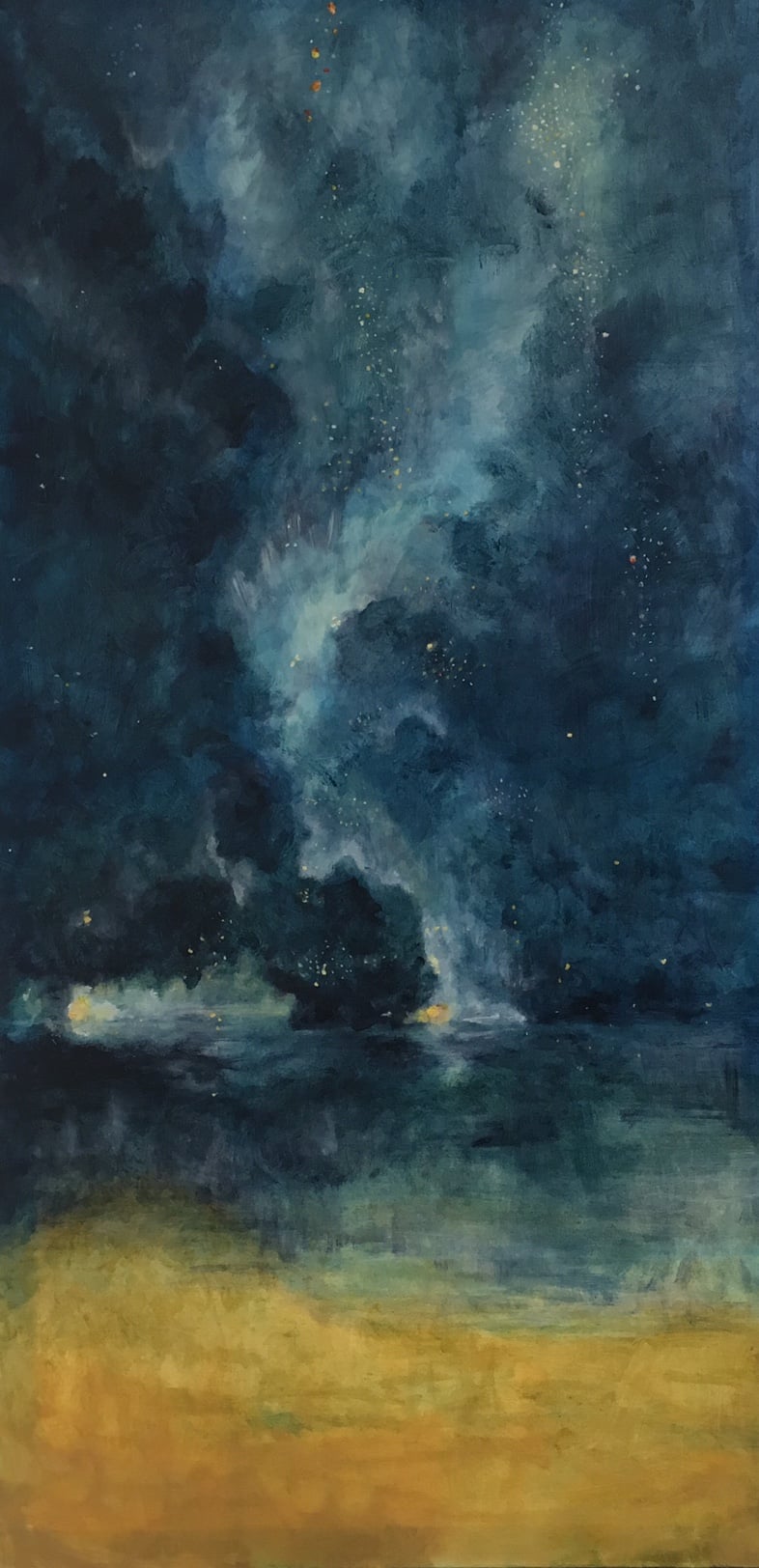
Nocturne: illuminations (work in progress i), oil on canvas. Usher. 2021.
A studio study of Nocturne in black and gold, (1874). Whistler. Detroit Institute of the Arts. The painting is based on the well known fireworks displays at Crenmore Gardens.
SPRING 2024
I AND THOU
Had I the heavens' embroidered cloths,
Enwrought with golden and silver light,
The blue and the dim and the dark cloths
Of night and light and the half light,
I would spread the cloths under thy feet:
But I, being poor, have only my dreams;
I have spread my dreams under thy feet;
Tread softly because Thou tread'st on my dreams."I and Thou" (Usher), a meditation on "Aedh Wishes for the Cloths of Heaven" W. B. Yeats (1865 – 1939), Irish poet and playwright
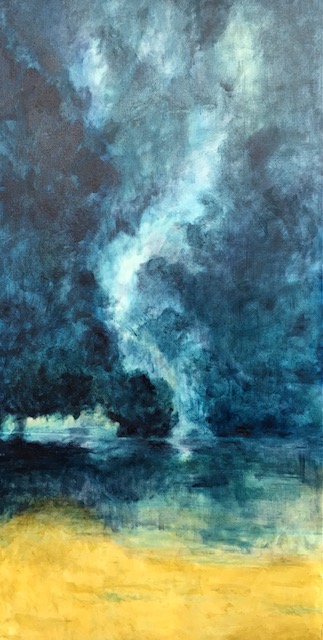
Nocturne: illuminations (work in progress ii), oil on canvas. Usher. 2021.
A studio study of Nocturne in black and gold, (1874). Whistler. Detroit Institute of the Arts. The painting is based on the well known fireworks displays at Crenmore Gardens.
SPRING 2024
AND WE
Had We the heavens' embroidered cloths,
Enwrought with golden and silver light,
The blue and the dim and the dark cloths
Of night and light and the half light,
We would spread the cloths under our feet:
But We, being poor, have only our dreams;
We have spread our dreams under our feet;
Tread softly because We tread on our dreams."And We" (Usher), a meditation on "Aedh Wishes for the Cloths of Heaven" W. B. Yeats (1865 – 1939), Irish poet and playwright
Nocturne: illuminations, oil on canvas. Usher. 2021.
A studio study of Nocturne in black and gold, (1874). Whistler. Detroit Institute of the Arts. The painting is based on the well known fireworks displays at Crenmore Gardens.
WINTER 2024
ALL THE TRUTH
Tell all the truth but tell it slant —
Success in Circuit lies
Too bright for our infirm Delight
The Truth's superb surprise
As Lightning to the Children eased
With explanation kind
The Truth must dazzle gradually
Or every man be blind —
"Tell all the truth but tell it slant", Emily Dickinson (1830 - 1886), poet.
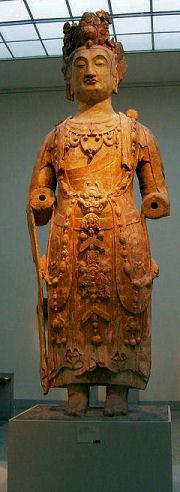
Standing Bodhisattva. Northern Qi Dynasty. 550-77. Sandstone with polychrome and gilt. [Sanskrit bodhisattvah, one who has attained perfect knowledge or enlightenment, from bodhih, perfect knowledge + sattvam, essence, being].
WINTER 2024
A CIRCUITOUS PATH
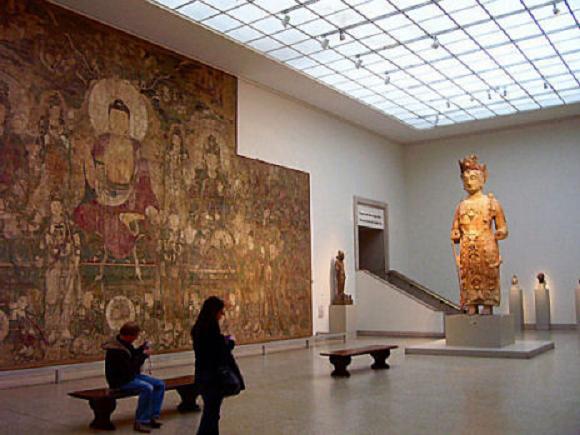
The Pure Land of Bhaishajyaguru. Water-based pigment over a foundation of clay mixed with straw. Yuan Dynasty. ca. 1319. Sackler Gallery, Metropolitan Museum of Art. New York.
In search of my mother's garden, I found my own.
Alice Walker (1944 - ), author, poet, activistNew York is full of places that restore the spirit. For instance, the parks are quite beautiful here. Riverside and Central Parks are the best known and the most sprawling. But there are smaller parks throughout the city, beautiful green gems that break the city rhythm with the comfort of a park bench, the chatter of a fountain, the unexpected intrusion of grass and trees.
Nature is a great healer and she has many temples. But art is a great healer as well and in a city full of museum-temples, the Sackler Gallery in the Metropolitan Museum of Art is a personal favorite.
Life as Myth, Collected writings, Usher. (2006 - ). Adapted from a 2007 essay.
WINTER 2024
FOLLOWING THE LIGHT
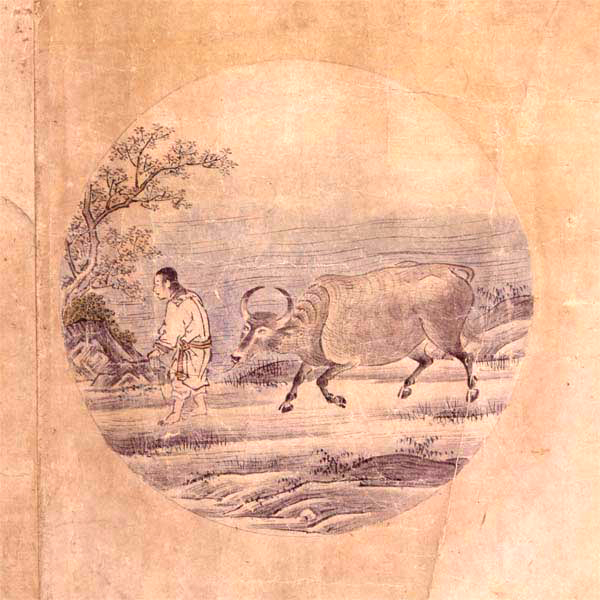
Picture Five: Taming the ox. Ten Oxherding Pictures. Attributed to Shubun (n.d.) Japan, Muromachi period. Handscroll, ink and light colors on paper. 9/8/2013
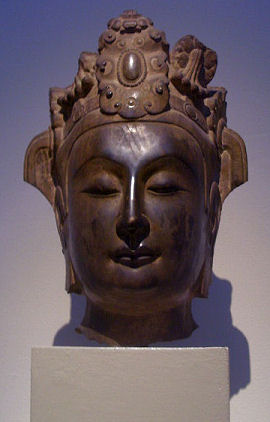
Head of Bodhisattva. Limestone. Northern Qi Dynasty. 550-77. Sackler Gallery. [Sanskrit bodhisattvah, one who has attained perfect knowledge or enlightenment, from bodhih, perfect knowledge + sattvam, essence, being].
Your vision will become clear only when you look into your heart . . . Who looks outside, dreams. Who looks inside, awakens.
C. G. Jung [1875-1961], Swiss psychiatristNew York is full of places that restore the spirit. For instance, the parks are quite beautiful here. Riverside and Central Parks are the best known and the most sprawling. But there are smaller parks throughout the city, beautiful green gems that break the city rhythm with the comfort of a park bench, the chatter of a fountain, the unexpected intrusion of grass and trees.
Nature is a great healer and she has many temples. But art is a great healer as well and in a city full of museum-temples, the Sackler Gallery in the Metropolitan Museum of Art is a personal favorite.
My first visit in October 2003 is not particularly vivid in my mind. The museum is so immense and its treasures so rich that only a few individual pieces secured a place in my memory. Perseus with the head of Medusa. A bronze Florentine mermaid. Shiva dancing in the ring of fire at the far end of a darkened gallery. But somewhere in my cluttered remembering there was also a place for one specific gallery, the Sackler Gallery, a vast open room with veils of white light and a massive weathered painting.
Life as Myth, Collected writings, Usher. (2006 - ). Adapted from a 2013 essay.
WINTER 2024
DAZZLED GRADUALLY
The Pure Land of Bhaishajyaguru. Water-based pigment over a foundation of clay mixed with straw. Yuan Dynasty. ca. 1319. Sackler Gallery, Metropolitan Museum of Art. New York.
But the obvious dynamism of these extravagant figures lies in the fact that they come alive in the dialectics of what is hidden and what is manifest.
Gaston Bachelard (1884 - 1962), The Poetics of SpaceNew York is full of places that restore the spirit. For instance, the parks are quite beautiful here. Riverside and Central Parks are the best known and the most sprawling. But there are smaller parks throughout the city, beautiful green gems that break the city rhythm with the comfort of a park bench, the chatter of a fountain, the unexpected intrusion of grass and trees.
Nature is a great healer and she has many temples. But art is a great healer as well and in a city full of museum-temples, the Sackler Gallery in the Metropolitan Museum of Art is a personal favorite.
My first visit in October 2003 is not particularly vivid in my mind. The museum is so immense and its treasures so rich that only a few individual pieces secured a place in my memory. Perseus with the head of Medusa. A bronze Florentine mermaid. Shiva dancing in the ring of fire at the far end of a darkened gallery. But somewhere in my cluttered remembering there was also a place for one specific gallery, the Sackler Gallery, a vast open room with veils of white light and a massive weathered painting.
Though vast and bright, the Sackler Gallery feels intensely intimate. I've photographed the room many times. I've spent hours with a sketching pad trying to capture the relationship between space and art and afternoon light. Yet it was only when I visited the gallery with a museum audio guide that I had an explanation of The Pure Land of Bhaishajyaguru, the painting which grounds the gallery.
Bhaishajyaguru is a bodhisattva and the healing Buddha. He cures illness, provides daily necessities and oversees the birth of healthy children. Bodhisattvas emanate a radiance which forms a "pure land" that fosters enlightenment. The pure land of each Buddha is not outside our world but is found embedded in it. When a bodhisattva attains enlightenment, he or she does not leave the world and its suffering but chooses to stay. Therefore, Bhaishajyaguru, Buddha of medicine, remains with us and within us creating a pure land for healing and enlightenment.
Life as Myth, Collected writings, Usher. (2006 - ). Adapted from a 2018 essay.
JOURNAL 2023
SABBATICAL
. . . It is certainly not necessary to abandon modern science and technology in order to bring our relationship with the planet and each other back into balance. The paradigm shift that is necessary here requires both our present and our past myths to inform our future one.
"The lost myth of planet earth", Usher. Collected writings (c. 2007)
During 2023, Life as Myth and its author are on sabattical.
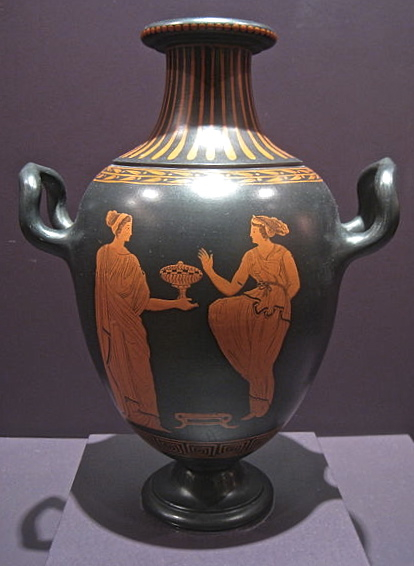
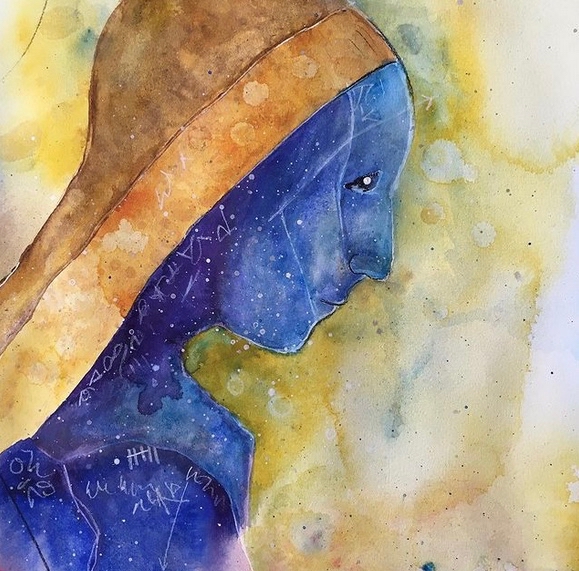
The illuminated codex of magical creatures, Usher, 2021. caption: “Plate XIV. Enteroctopus andromada with prey. Ancestor to Giant Pacific Octopus (Enteroctopus dofleini, previously Octopus apollyon).”
.
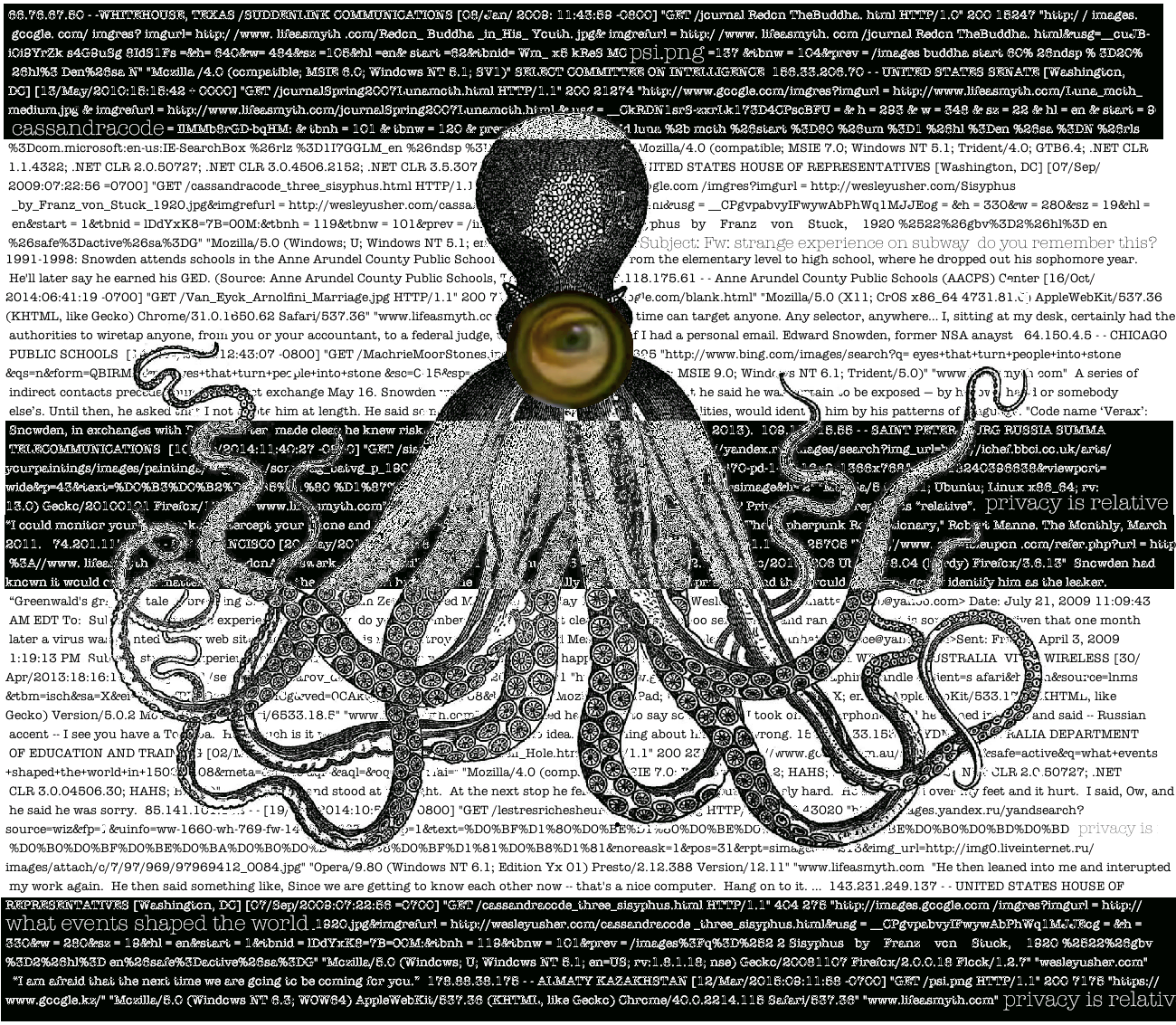
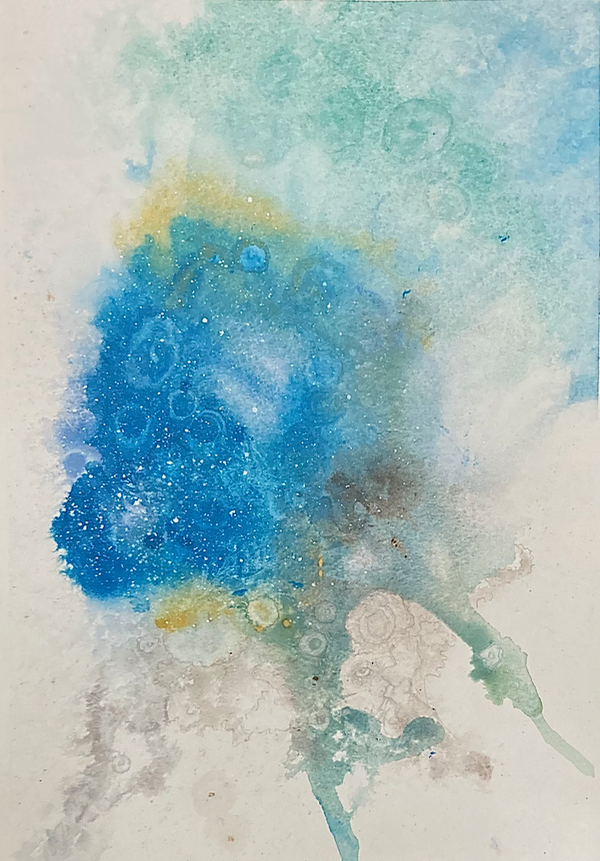
Panocticon aka Panoptipus, Usher, 2015. Source: web access logs, current news quotes, a 19th Century lithograph of a sea monster, 20th Century photograph.
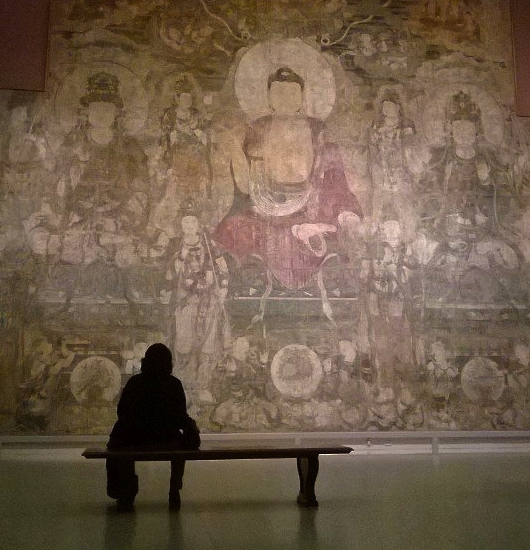
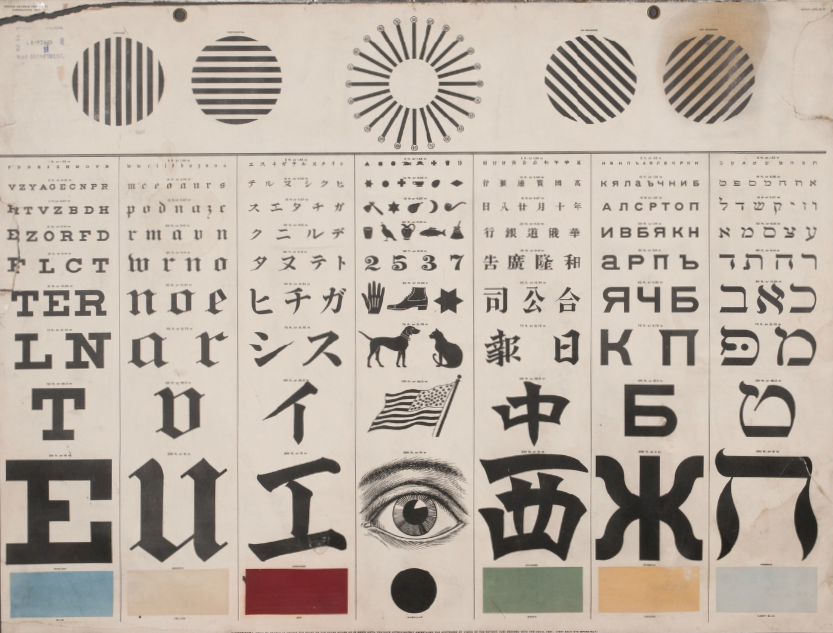
Eye test chart. George Mayerle. Images from the History of Medicine (IHM) 1907. Public Domain.
National Library of Medicine, NIH, caption: George Mayerle's eye test chart "combined four subjective tests done during an eye examination. Running through the middle of the chart, the seven vertical panels test for acuity of vision with characters in the Roman alphabet (for English, German, and other European readers) and also in Japanese, Chinese, Russian, and Hebrew. A panel in the center replaces the alphabetic characters with symbols for children and adults who were illiterate or who could not read any of the other writing systems offered. Directly above the center panel is a version of the radiant dial that tests for astigmatism. On either side of that are lines that test the muscular strength of the eyes. Finally, across the bottom, boxes test for color vision, a feature intended especially (according to one advertisement) for those working on railroads and steamboats."













JOURNAL 2022
MOONBEAR MUSEUM
My very first memories are of my childhood home, Lamara Apartments, a duplex community in Savannah, Georgia. It is January, just after my sister was born. I am sitting on the concrete stoop and the green space just outside our duplex sparkles with snow. Just past my feet there is a tiny snowman that my mother made; its eyes are two small pieces of red cinnamon candy and they are slowly staining the snow a deep rose red. My mother leans out the back door and checks on me and then returns inside. A new sister and a miraculous Savannah snow, my toes and fingers aching with cold, a small snowman with stained cinnamon eyes. The first memories of home.
Flash forward many decades to another place, another time and another snow.
In the winter of 2014, I was living in the upper most reaches of Manhattan and it was to be my last New York winter. It snowed heavily, stirring that old childlike thrill as it thudded against coat, caught on eyelashes and hair, crunched beneath boots.
My big dog Sophie and I took long walks in the nearby nature preserve. Sometimes I let her off leash and she barreled forward, her nose buried in the powdery white, occasionally turning her head over her shoulder to feast on feathery flakes caught in her fur.
But, for all the snowy magic, something was missing -- a sense of roots, of safety and belonging maybe, a sense of home. This was not home as I knew it -- the one from my coastal Savannah childhood, all marsh mud and chiggery Spanish moss and salt sea air. Not like the one from my midland Georgia adulthood either, with a crookedy cottage on a crookedy creek, sandy flood plain alive with chipmunks and slippery black snakes, and a Great Blue Heron walking the creeks shoals on stilted legs looking for fish. Somewhere "home" waited for me and in the spring of 2014 I decided to leave New York and return to Georgia, the last place I remembered that felt like "home".
The return to Georgia has gone in very unexpected directions. It feels less like taking up where I left off and more like starting all over again. And if I thought moving back would mean fewer problems and cares. Well, wonder of wonders, the problems I had to manage in New York have followed me down the eastern seaboard and set up residence here as well.
Hmmm. Is it possible for any of us to find our way home again? The answer is no and yes. On the one hand, no, we can't return to the worlds of our childhood or our young adulthood or whatever familiar and comfortable "home" where we once resided. On the other hand, yes, we can. Or, to put it another way, -- yes, we can return home.
Home is knowing. Knowing your heart, knowing your mind, knowing your courage. If we know ourselves, we're always home, anywhere.
This homey quote is probably familiar to you if you have ever witnessed the exchange between Glinda the Good Witch and Dorothy at the conclusion of The Wizard of Oz.
Here's my own personal returning-to-Kansas-discovery. Somewhere in me still lives the child from the Savannah beaches and marsh, the mother and wife and artist of the North Georgia creeks and flood plains. I treasure those times but I remember them (I hope) with as little nostalgia as possible. The key has been to truthfully hold the reality of home, allowing for both its perfections and its flaws. Somewhere in that idea, there is a truth that is larger than "home". Somewhere in that idea of home, there is a key to how we hold our relationships, our work, our lives, about how we hold our very world in our hands.
You always had the power, my dear. You just had to learn it for yourself.
Glinda again to Dorothy.
I return again to home, my new-old home, and the place I dreamed about during a snowy winter in New York. In my neighborhood there are eight free-range chickens five doors down. From time to time their eggs are for sale on Facebook. One homeowner recently hired a herd of goats to clear thickets out of an ovegrown greenspace. There is another neighbor who has built a small dog house in their side yard for the exclusive use of a territorial possum (who never plays dead). At Christmas the entire area is a crazy display of over the top lights and inflatable decorations.
My little house remains a stenciled-half-painted-patched-up-work-in-progress but welcomed the first official family celebration a few years back. And just before that first crowded celebration began, in a neighborhood park, on a small wooden bridge near a stand of dancing water grasses, my son gave his fiancé her ring. My hands are reverently holding it all, a home brimming over with chickens, goats, stenciled floors, crazy holiday lights, possum houses and love on a bridge over water grasses.
. . . My particular edition of Pilgrim’s Progress was an abbreviated one and featured whimsical stick figure illustrations. The sole feature that distinguished Pilgrim from the rest of the company was a simple egg-shaped loop on the back, representing a “great burden.”
I thought about Pilgrim’s Progress throughout the winter of 2014, along with the great burden on my back, a burden I could not or would not abandon. I also thought about Pilgrim’s final companion, Hopeful, who did nothing to lighten Pilgrim’s burden on the way to the Celestial City. Rather, Hopeful simply made it possible to complete the journey.
A winter walk in the Shorakapok Preserve in Inwood Hill Park, Manhattan. Maintained by the New York City Parks Department, the preserve holds some of the only natural forest and salt marsh in Manhattan. There are numerous hiking trails, featuring caves formed by natural rock overhangs and once used by Native Americans.
STORY TELLING SEASONSamhain approaches. It's an ancient holiday, officially beginning at sunset on October 31.* Lasting three days, Samhain marks the end of the harvest and the beginning of the "dark half" of the year. According to Celtic mythology, it is a time of enchantment, a time when both mortal and immortal can pass back and forth between this world and the Otherworld. Like many of the Celtic holidays, Samhain aligns exactly with a Christian observance -- All Hallows Eve, All Saints Day, and All Souls Day (October 31- November 2).
Samhain marks the time of year when the ancient Celts began their storytelling cycles, gathered as a community around the winter fires. This cycle continued throughout the "dark half" of the year, until Beltane, May 1, when the warm weather and agricultural duties required full attention.
Recognizing the approach of the storytelling season, I have put together a narrative cycle of my own. This fall I am revisiting the Ten Oxherding pictures. What I particularly like about this series is how the path to enlightenment concludes by returning us to the world and the human experience. The series reflects precepts of Zen meditation, a Japanese tradition of Buddhism (Mahayana) that emphasizes a combined spiritual practice of meditation and intuition. In other words, in order to truly understand these images, we must reflect and intuit their meaning.
The writing that accompanies these illustrations incorporates ideas from this web site. In that way, this particularly telling of the Ten Oxherding pictures explores the idea of a living myth. And if you take time to reflect and intuit, you might discover more than the writing itself.
*Samhain celebrations traditionally coincide with All Hallow's Eve (Halloween, October 31). However, Samhain is a cross-quarter day, meaning the actual date lies at the midpoint between the autumn equinox and the winter solstice. Varying from year to year, in 2013/2017/2022 the date is November 7.
The four evangelists (detail, St. Luke as the ox). The Book of Kells. Trinity College, Dublin. ca. 800 AD.
This winged ox is the spiritual symbol of St. Luke. Luke was an apostle of Christ, a doctor and a writer (Gospel of Luke, Acts of the Apostles). Tradition also credits him with the creation of the first icon of Mary and Jesus. The Guild of Saint Luke, one of the earliest artists guilds, takes its name from this legend. Luke is the patron saint of artists and healers. His feast day is October 18.
Ox: ochse, German origin; also Dutch os, from the Sanskrit uksan, meaning bull; in Zen Buddhism, a symbol for enlightenment.
JOURNAL 2021
THE LESSONS IN THE PEACH
Though Georgia is the self-proclaimed "peach state" I heard once that they actually grow more peaches in South Carolina. That feels right to me because when I was a little girl that is where we always went to buy them. During the summer months (usually starting in June) we would pile into my mother's blue and white Plymouth station wagon, cross over the Talmadge Bridge and head in the general direction of Hardeeville, South Carolina. That's where they had roadside stands which sold fresh fruits and vegetables, fruits and vegetables so fresh, in fact, that they had been picked that very morning. Yellow corn with silk tasseled tips, vine ripened tomatoes, pole beans, yellow squash, swollen snake-skinned watermelons. And, of course, peaches, fuzzy skinned and sticky sweet.
And something rather like that might be found in the mythology surrounding Hsi Wang Mu, ruler of the western paradise and keeper of the Peaches of Immortality.
The jade palace of Hsi Wang Mu is on the peaks of the snowy mountain range of K'un-lun and is the home of the Immortals. According to Taoist myth, the peach orchards of Hsi Wang Mu leaf out once every three thousand years but it is only after an additional three thousand years that the trees bear a season of fruit. The banquet to celebrate this event takes place on the shores of the Yao Ch’ih (Lake of Gems) and attended by the Immortals. The feast includes such delicacies as dragon liver and phoenix marrow. The highlightis the, rarest of rare, Immortal Peach, which has the magical property of bestowing immortality on all who taste it.
Two stories with two peaches. The first peach linked to South Carolina summers and station wagons and the pleasures of a roadside fruit. The second linked to a jade palace and a Chinese goddess and the gift of immortality. Any connection between the two? Yes, it has to do with our mortality. And when the stories are viewed through that mythic lens, a somewhat larger question emerges -- which is -- how do I bridge the gap (inside myself) between mortal living and immortal Life?
With midlife comes the specter of our own mortality. And the more palpable presence of Death can bring chaos, disruption, depression, withdrawal, or any other number of psychological demons. However, our mortality is, in fact, a gift -- because it is only by awakening to our own mortality that we create the possibility of receiving the gift of our immortality.
So what does that mean? It's about crafting a life which lies somewhere between the back seat of a Plymouth station wagon and the shores of the Lake of Gems. And what lies in between is -- who you are, the essence of who you really are, your particular spark of the divine fire. Not what you have always been told you are or who you ought to be -- but who you really are and the life that expresses that divine spark.
The challenge is what happens on the way to the Lake of Gems -- the lessons found in Life's obstacles, setbacks, self-doubt, suffering.
Over the years I have watched many times the PBS series, The Power of Myth. The program is a six hour documentary which features conversations between Joseph Campbell, noted mythological scholar, and television journalist Bill Moyers. Taped in 1988 shortly before Campbell's death, The Power of Myth explores the transformative potential of myth for the individual and the society as a whole.
Last night as I struggled with writer's block on how to finish this piece, I turned again to Campbell and Moyers. When I placed the DVD into the player it continued where I had apparently left the program from the last time. And with that section, I now conclude.
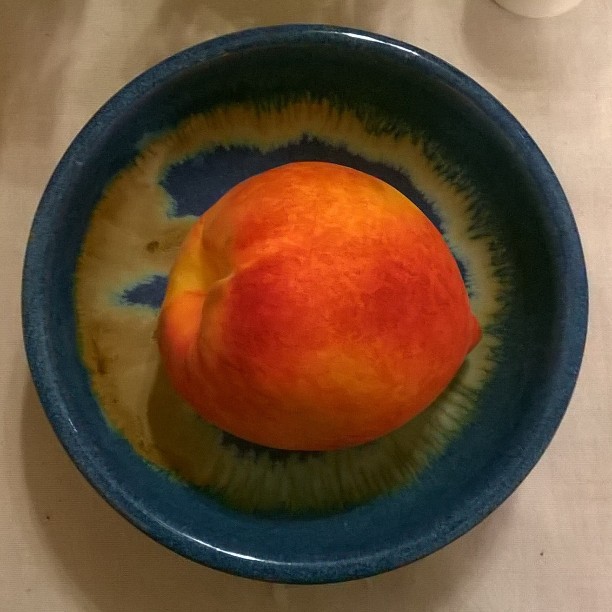
Peach in a lapis bowl. Usher. 2015.
Moyers: What is the adventure that I have to take, you have to take? You talk of something called a soul's high adventure.
Campbell: My general formula for my students is "follow your bliss." Find where it is and don't be afraid to follow it.
Moyers: Can my bliss be my life's love or my life's work? Is it my work or my life?
Campbell: Well, if the work you are doing is the work you chose to do because you enjoy it, then that's it. But if you think, "Oh, gee, I couldn't do that." That's your dragon, locking you in.
Moyers: Unlike the classical heroes, we're not going on the journey to save the world but to save ourselves.
Campbell: And in doing that you save the world. I mean you do. The influence of a vital person vitalizes. There's no doubt about it. The world is a wasteland. People have the notion of saving the world by shifting it around and changing the rules and so forth. No. Any world is a living world if it is alive. And the thing is to bring it to life. And the way to bring it to life is to find where it is in your own life and be alive yourself.
Moyers: You say I have to take that journey and slay those dragons. Do I have to go alone?
Campbell: If you have someone who can help you, that's fine, too. But ultimately the last trick has to be done by you.
JOURNAL 2020
ONCE UPON A TIME
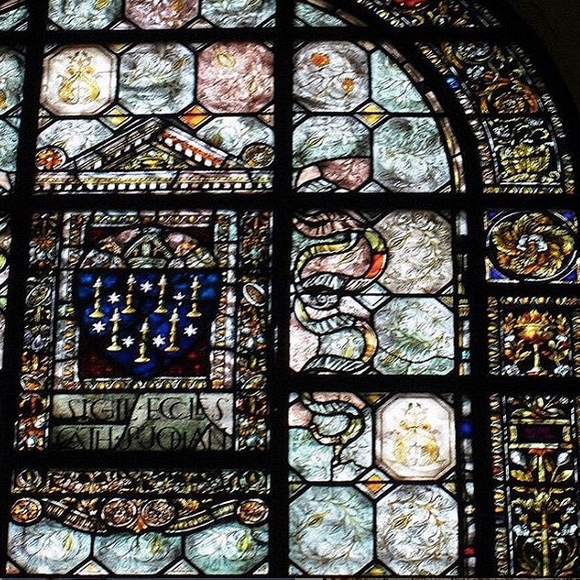
St. Ambrose chapel, The Cathedral of St. John the Divine. Usher, New York, NY.
I love illuminated manuscripts and they were an influence on this work but stained glass is probably a better metaphor for the project, as the piece narrates the transformation of color through the lens of one day. Consider. If you watch a stained glass window you will see it change. The window glass remains fixed but when combined with light, as it is meant to be, the glass transforms over time. It's more than the shifting of colors. If you watch carefully, it can also hold the flickering shadow of branches or a bird's wings. It can shift the light in the interior space, as a chapel brightens or dims or holds a puddle of rainbow light on floor and walls. [Let's] consider the fundamental truth of the stained glass: Time is at play in the world. - "Once upon a time" (2018)
Over Christmas dinner. One of my sons asks, What's your New Year's resolution?
I didn't have an answer. I mostly thought about the gift of Time.
Life has provided a reminder very recently that we're not immortal. Mine was -- I injured my spine this fall. It took longer to heal than expected but I'm finally on the road back. I’m also really grateful for the good people at the spine clinic that have helped me get here.
New Year's resolution. What to do with the gift of my time? When Mom died -- it was around last year this time -- someone asked which one of her children love to garden, too. And the answer from my sibs was "Wesley". Isn't it strange to hear things about yourself through others' eyes? I haven’t thought of myself as a “gardener” though I've been planning a garden ever since I moved back to Georgia. So maybe this is the year to figure out a way to push that dream garden further along.
New Year's resolution and what to do with the gift of my time?
There's one other thing about Mom. Her love of writing and her wish that she had given more of her time to it. She advocated for me to write all my adult life -- and that is knocking around in my head today as I reflect on how I might invest my precious gift of time. Not what to dabble in during the next year. But what to invest in. Since the spine injury I've made a few lifestyle changes that might be steps forward. One change is a standing desk in my little studio. Just waiting for me every morning -- to put pen to paper, paint to paper, hands to keyboard.
An explanation for the photo in this post. It’s a stained glass window from the Cathedral of St. John the Divine, one of my favorite places - anywhere. Today is the feast day of St. John. Patron saint of love, loyalty, friendships, and all things writing. So I'm writing this morning and going over my old journals and thinking about the garden of my recent dreams. And feeling grateful for love and friendship and healing and Mom. And for the gift of time.
New Year’s resolution? Carpe diem, y’all.
JOURNAL 2019
THE GOLDEN THREAD
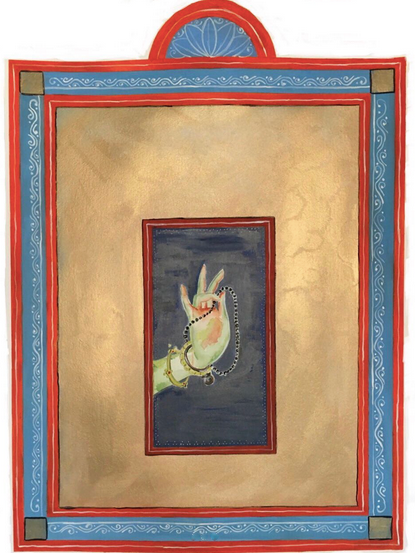
Green Tara, gouache on paper, Usher, 2019
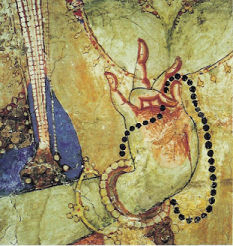
Green Tara, Mural detail, artist and date unknown.
No experience has been too unimportant,
and the smallest event unfolds like a fate,
and fate itself is like a wonderful, wide fabric
in which every thread is guided by an infinitely tender hand
and laid alongside another thread
and is held and supported by a hundred others.
Rainer Maria Rilke, Letters to a Young Poet (April 23, 1903)
Over this past year or so, all the appliances in my kitchen broke. Disposal, stove, dishwasher, microwave. Everything, except the refrigerator. Contrary to the ancient wisdom that says don't leave things broken because that will attract more broken things into your world, I let them rest in peace in my kitchen and reverted to no-microwave, no-disposal, patch-and-mend-dishwasher and toaster-oven living.
Then last spring I had a conversation with the kitchen fairy. You see, the appliances weren't the only problem. The DIY kitchen cabinets featured doors made out of old windows and, consequently, wouldn't pass safety codes, much less an energetic bump from one of my mammoth dogs. And the giant concrete laundry basin that masqueraded as my kitchen sink never drained properly and was home to black mold (all the time).
To repair or not to repair? No easy answer. There's the possibility I might have to leave my home next year so why bother? But we decided, the kitchen fairy and I, that I should probably just take a step in faith and pull everything out. The house would probably sell for more, if it came to that, and I could actually cook in the meantime. In late June I began what was to be a four month process of redoing the kitchen.
There were losses along the way. One of the cabinet shelves collapsed due to flimsy shelf clips and heaved my mother's blue willow china on to the floor. Lost quite a few pieces to the clip debacle. Then one of the carpenters dropped a screw driver from a terrible height on a pile of pretty painted dishes. Seriously, how that sharp-shooting screwdriver managed to navigate through boards and cabinets to land squarely on a helpless little dish is nothing short of remarkable. I picked up the various broken bits and put them on the dining room table to toss out later.
Then one more break -- when I fell hauling construction debris to the street -- spraining one uninsured foot and breaking the equally uninsured other. I couldn't drive. I couldn't walk. I crawled around on my hands and knees. I slept on the sofa for weeks. I cooked frozen meals in a toaster oven on a trunk at the end of the sofa. Shortly after my fall, the carpenters disappeared after receiving their first paycheck. Life didn't stop for chaos but thanks to a whole lot of help from friends and family the groceries arrived, there was help with trips to the orthopedic clinic, etc. Even the remaining subcontractors found all kinds of ways to extend unexpected kindness. Hauling away debris. Buying me a pair of plumber's knees to cushion my crawling.
My son saw the ceramic remains, ready for the garbage heap, and asked why I didn't just repair it. Had I heard of kintsugi? Kintsugi means "golden joinery". Using a lacquqer mixed with gold, silver, or platinum, artisans repair broken objects in a way that highlights the damage. When an object breaks, that's just part of its story and a reason for celebration. How had I never heard of this?
Hearing my summer story a wise friend asked whether there was a lesson that Life might be offering me. Well, that's a complicated idea, I said, while crawling to the toaster oven. But maybe Life did want me to learn something new. If I can apply kintsugi principles to last summer, to all my summers, maybe I'll see my life with new eyes -- messy, unpredictable, sublimely beautiful at the broken places.
JOURNAL 2018
WHAT WE MIGHT BEWhen I let go of what I am, I become what I might be.
Lao Tzu (604-531 B.C.), philosopher, author of Tao Te Ching
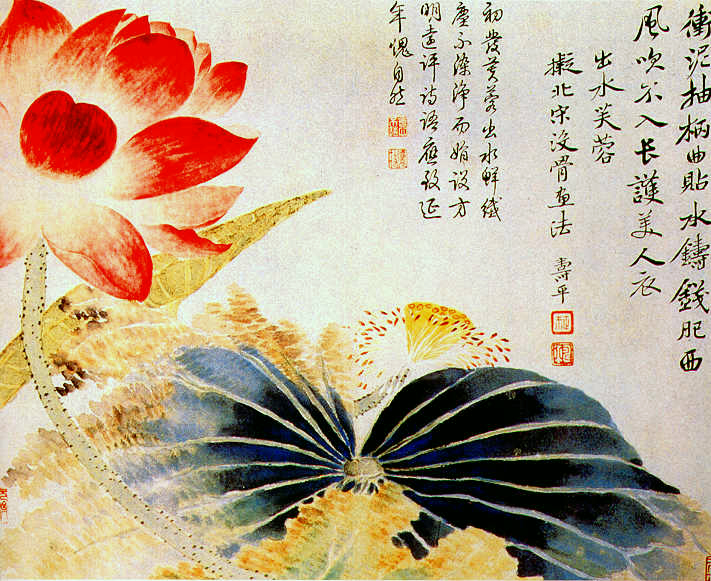
As a symbol of rebirth, the lotus (interchangeable with the water lily) appears throughout world mythology. Its earliest mythic origins might be Egyptian where the lotus and the water lily are interchangeable icons for creation and rebirth. An eight-petalled flower, bearing a striking resemblance to later Buddhist depictions of the lotus, also shows up in the stone face of a 7000 year old passage tomb in Loughcrew, County Meath, Ireland.
Though rooted in muddy and watery habitats, lotus are never wet or soiled. A drop of water on a lotus leaf or blossom will roll off, carrying dirt and debris with it. This journey of the unblemished lotus, from mud and water into air and light, has become a symbol for the journey of the soul.
A lotus breaking the surface. Yun Shouping. 17th century, Qing Dynasty. Palace Museum, Beijing.