LIFE AS MYTH

JOURNAL
JOURNAL 2011
Life as Myth
Naming a life
LIFEWORKS
ATLAS

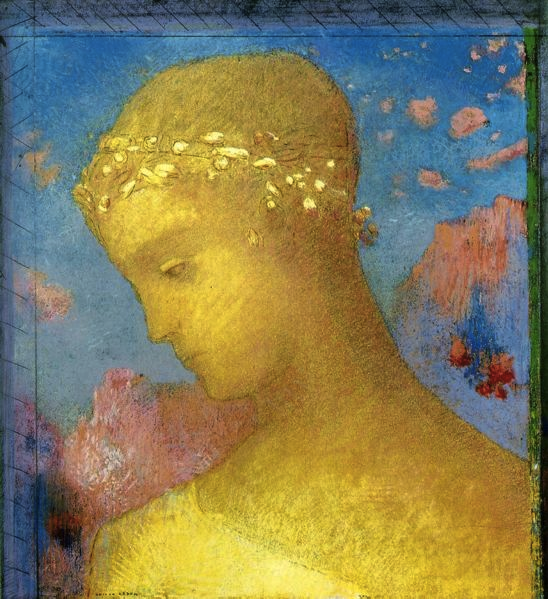
Beatrice. Odilon Redon. 1897. Fine Arts Museum of San Francisco. Beatrice is the legendary muse and great love of the Italian poet Dante Alighieri.
Myth is an attempt to narrate a whole human experience, of which the purpose is too deep, going too deep in the blood and soul, for mental explanation or description.
D. H. Lawrence (1885-1930) novelist, poet, essayistSymbolism was a multi-disciplinary arts movement, most active in the late nineteenth century. The Symbolist movement rejected naturalism and realism in favor of spirituality, the imagination and dreams. One development which contributed to the movement was the emergence of modern psychology.
The work of both Sigmund Freud (1856-1939) and Carl G. Jung (1875-1961) was particularly influential to the development of Symbolism. During this period, they provided ground-breaking insights into the interpretation of imaginative, symbolic and dream material. Freud believed that repressed aggression and sexuality are at the root of human behavior. In his therapeutic practice, he explored dream material for insights into these unconscious drives and their effect on human behavior. He noted that some patients repeatedly relived past traumas in their dreams. According to Freud, over the course of repetitive dreaming, the dreamer often added details about the nature of the original injury. The function of this process was to help the patient obtain mastery over the traumatic event.
Jung, a protege of Freud, disputed his mentor's premise of aggression and sexuality as the sole motivating forces behind human behavior. His areas of research broadened to include not only dream material, but art, mythology, religion and philosophy. His major contributions to the field of psychoanalysis are the Jungian archetypes and the concepts of synchronicity and the collective unconscious.
Paul Gauguin organized the first Symbolist art exhibition in 1889-90 at the Paris World's Fair. Better known Symbolist visual artists include Redon, Gustav Klimt, William Blake (as both artist and poet), Edvard Munch, Gustav Moreau and Arnold Bocklin. Historians credit Charles Baudelaire (1821-1867) as the forerunner of Symbolist poetry. Symbolist poets include William Butler Yeats, Stéphen Mallarmé and T. S. Eliot. The extensive list of Symbolist authors includes Edgar Allen Poe, George MacDonald, and Oscar Wilde.