
ARCHIVES


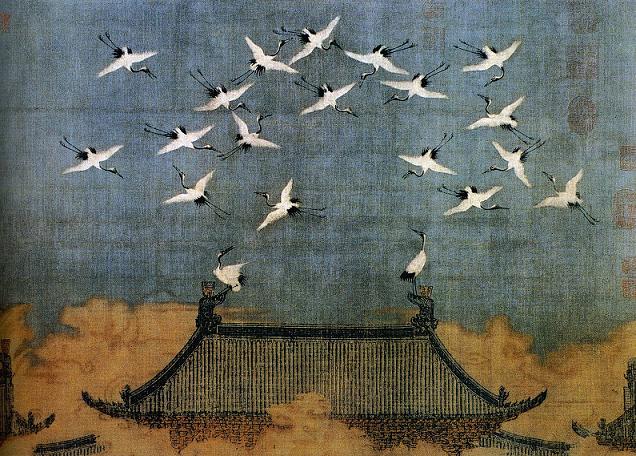
Auspicious cranes. Huizong of Song. 1112. Liaoning Provincial Museum. There is a report in this book that a large flock of cranes gathered around a palace building. This was an auspicious omen and Huizong wrote a poem to commemorate the occurence. One thousand origami cranes held together by string is a senbazuru. According to Japanese tradition, if you fold one thousand origami cranes, you will receive your heart's desire.
AMBASSADORS FOR PEACE... Cranes have come to play a unique role as ambassadors for peace, helping peoples from different countries to recognize the common ground that unites them. Principles and methods developed through the study and conservation of cranes have contributed to the foundation of broader national, international, and regional programs for the conservation of biological diversity and the implementation of the idea of sustainable land use. Meine, Curt D. and George W. Archibald (Eds). 1996. The cranes: Status survey and conservation action plan. IUCN, Gland, Switzerland, and Cambridge, U.K. 294pp. Northern Prairie Wildlife Research Center Online.
http:// www. npwrc. usgs. gov /resource /birds /cranes/ index. htm (Version 02MAR98).
There are fifteen living species of cranes. But due to pollution, a loss of habitat, and other environmental factors, eleven of the fifteen species are listed as either vulnerable, endangered, or critically endangered.
Three species, Whooping, Red-crowned and Siberian cranes, have populations with such low numbers that extraordinary conservation efforts are underway to insure their survival.
The Whooping Crane, with a total population of 485, reached the brink of extinction in the 1940's and is now one of the world's rarest and most carefully managed wildlife species. They are wondrous creatures, standing nearly five feet tall with a wingspan of almost eight. Their name comes from their distinctive cry.
